Extreme Minimalism With a Focus on Geometry Typifies Which Art Movement

Systems fine art is art influenced past cybernetics, and systems theory, that reflects on natural systems, social systems and social signs of the fine art world itself.[ane]
Systems art emerged as office of the beginning wave of the conceptual art movement extended in the 1960s and 1970s. Closely related and overlapping terms are anti-form movement, cybernetic art, generative systems, process art, systems aesthetic, systemic art, systemic painting, and systems sculptures.
[edit]
Anti-form motility [edit]
Past the early 1960s, minimalism had emerged equally an abstruse motion in art (with roots in geometric abstraction via Malevich, the Bauhaus and Mondrian) which rejected the idea of relational, and subjective painting, the complexity of abstract expressionist surfaces, and the emotional zeitgeist and polemics present in the arena of action painting. Minimalism argued that farthermost simplicity could capture all of the sublime representation needed in art. The term Systematic fine art was coined by Lawrence Alloway in 1966 as a description of the method artists, such as Kenneth Noland, Al Held and Frank Stella, were using for composing abstract paintings.[2]
Associated with painters such every bit Frank Stella, minimalism in painting, equally opposed to other areas, is a modernist movement. Depending on the context, minimalism might be construed as a precursor to the postmodern movement. Seen from the perspective of writers who sometimes classify it as a postmodern movement, early minimalism began and succeeded as a modernist move to yield advanced works, just which partially abandoned this project when a few artists changed direction in favor of the anti-form move.
In the belatedly 1960s, the term postminimalism was coined past Robert Pincus-Witten[3] to describe minimalist derived fine art which had content and contextual overtones which minimalism rejected, and was applied to the piece of work of Eva Hesse, Keith Sonnier, Richard Serra and new work past sometime minimalists Robert Smithson, Robert Morris, Bruce Nauman, Sol LeWitt, and Barry Le Va, and others. Minimalists like Donald Judd, Dan Flavin, Carl Andre, Agnes Martin, John McCracken and others continued to produce their late modernist paintings and sculpture for the remainder of their careers.
Cybernetic fine art [edit]
Audio feedback and the employ of Tape loops, audio synthesis and estimator generated compositions reflected a cybernetic sensation of information, systems, and cycles. Such techniques became widespread in the 1960s in the music industry. The visual furnishings of electronic feedback became a focus of artistic research in the late 1960s, when video equipment showtime reached the consumer market. Steina and Woody Vasulka, for case, used "all manner and combination of audio and video signals to generate electronic feedback in their respective of corresponding media."[4]
With related work past Edward Ihnatowicz, Wen-Ying Tsai and cybernetician Gordon Pask and the animist kinetics of Robert Breer and Jean Tinguely, the 1960s produced a strain of cybernetic art that was very much concerned with the shared circuits inside and between the living and the technological. A line of cybernetic art theory also emerged during the late 1960s. Writers like Jonathan Benthall and Gene Youngblood drew on cybernetics and cybernetic. The most substantial contributors here were the British artist and theorist Roy Ascott with his essay "Behaviourist Art and the Cybernetic Vision" in the periodical Cybernetica (1966–67), and the American critic and theorist Jack Burnham. In Beyond Modern Sculpture from 1968, Burnham builds cybernetic art into an extensive theory that centers on art'southward drive to imitate and ultimately reproduce life.[v] As well in 1968, curator Jasia Reichardt organized the landmark exhibition, Cybernetic Serendipity, at the Constitute of Gimmicky Art in London.
Generative systems [edit]

Generative art is fine art that has been generated, composed, or synthetic in an algorithmic style through the use of systems divers by reckoner software algorithms, or similar mathematical or mechanical or randomised autonomous processes. Sonia Landy Sheridan established Generative Systems equally a program at the School of the Fine art Institute of Chicago in 1970 in response to social alter brought well-nigh in part by the estimator-robot communications revolution.[6] The programme, which brought artists and scientists together, was an effort at turning the artist'south passive role into an active one by promoting the investigation of contemporary scientific—technological systems and their relationship to art and life. Different copier art, which was a simple commercial spin-off, Generative Systems was really involved in the development of elegant yet elementary systems intended for creative apply past the general population. Generative Systems artists attempted to bridge the gap between elite and novice by directing the line of communication between the two, thus bringing starting time generation information to greater numbers of people and bypassing the entrepreneur.[6]
Process art [edit]
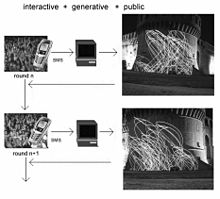
Maurizio Bolognini, Collective Intelligence Machines series (CIMs, from 2000). These are generative and interactive installations using the mobile phone network and participation technologies taken from due east-democracy.[7]
Process art is an artistic motion too equally a creative sentiment and earth view where the end product of fine art and craft, the objet d'fine art, is not the principal focus. The 'procedure' in process fine art refers to the process of the formation of fine art: the gathering, sorting, collating, associating, and patterning. Procedure art is concerned with the actual doing; fine art equally a rite, ritual, and operation. Process art often entails an inherent motivation, rationale, and intentionality. Therefore, art is viewed every bit a creative journeying or process, rather than as a deliverable or end product.
In the artistic discourse, the piece of work of Jackson Pollock is hailed as an ancestor. Process art in its employment of serendipity has a marked correspondence with Dada. Alter and transience are marked themes in the process art movement. The Guggenheim Museum states that Robert Morris in 1968 had a groundbreaking exhibition and essay defining the movement and the Museum Website states as "Process artists were involved in issues attendant to the body, random occurrences, improvisation, and the liberating qualities of nontraditional materials such as wax, felt, and latex. Using these, they created eccentric forms in erratic or irregular arrangements produced by actions such equally cutting, hanging, and dropping, or organic processes such as growth, condensation, freezing, or decomposition".[viii]
Systemic art [edit]
According to Chilvers (2004), "earlier in 1966 the British art critic Lawrence Alloway had coined the term "Systemic art", to describe a type of abstruse art characterized by the apply of very uncomplicated standardized forms, usually geometric in character, either in a single concentrated prototype, or repeated in a system arranged according to a clearly visible principle of organization. He considered the chevron paintings of Kenneth Noland every bit examples of Systemic art, and considered this as a branch of Minimal art".[ix]
John Yard. Harries considered a common ground in the ideas that underlie developments in 20th-century fine art such as Serial art, Systems Art, Constructivism and Kinetic art. These kind of arts often do not stem directly from observations of things visible in the external natural environs, but from the observation of depicted shapes and of the relationship between them.[10] Systems art, co-ordinate to Harries, represents a deliberate try by artists to develop a more flexible frame of reference. A style in which its frame of reference is taken equally a model to be emulated rather than as a cognitive systems, that only leads to the institutionalization of the imposed model. But to transfer the meaning of a picture to its location inside a systemic construction does not remove the need to define the constitutive elements of the system: if they are not defined, one will not know how to build the system.[10]
Systemic painting [edit]
Systemic Painting, according to Auping (1989), "was the title of an highly influential exhibition at the Guggenheim Museum in 1966 assembled and introduction written by Lawrence Alloway as curator. The testify independent numerous works that many critics today would consider part of the Minimal art".[11] In the catalogue Alloway noted, that ... "paintings, such as those in this exhibition are not, every bit has been oft claimed, impersonal. The personal is not expunged by using a peachy technique: anonymity is not a consequence of highly finishing a painting".[12] The term "systemic painting" later on on has go the proper name for artists who employ systems make a number of aesthetic decisions earlier commencing to paint.[13]
Systems sculpture [edit]
Co-ordinate to Feldman (1987), "serial art, serial painting, systems sculpture and ABC art, were art styles of the 1960s and 1970s in which uncomplicated geometric configurations are repeated with little or no variation. Sequences becomes important every bit in mathematics and linguistic context. These works rely on simple arrangements of basic volumes and voids, mechanically produced surfaces, and algebraic permutations of grade. The touch on on the viewer, however, is anything but elementary".[14]
See as well [edit]
- Algorithmic fine art
- Computer art
- Conceptual art
- Design
- Evolutionary art
- Fractal art
- Generative art
- Information fine art
- Interactive art
- Media art
- Process music
- Software art
- Sustainable art
- Systems thinking
- Systems music
References [edit]
- ^ Systems art, Dutch Art & Architecture Thesaurus, retrieved March 2008.
- ^ Chilvers, Ian and Glaves-Smith, John, A Dictionary of Modern and Contemporary Art, second edition (Oxford and New York: Oxford University Press, 2009), p. 694. ISBN 0199239665.
- ^ Movers and Shakers, New York, "Leaving C&Thou", by Sarah Douglas, Art+Auction, March 2007, V.XXXNo7.
- ^ Edward A. Shanken, "From Cybernetics to Telematics: The Art, Pedagogy, and Theory of Roy Ascott," in Roy Ascott (2003, 2007), Telematic Embrace: Visionary Theories of Art, Technology, and Consciousness, University of California, ISBN 0-520-22294-six.
- ^ Mitchell Whitelaw (2004), Metacreation: Art and Bogus Life, MIT Printing, ISBN 0-262-23234-0 p.17-18.
- ^ a b Sonia Landy Sheridan, "Generative Systems versus Copy Art: A Description of Terms and Ideas", in: Leonardo, Vol. 16, No. 2 (Leap, 1983), pp. 103–108. doi:ten.2307/1574794
- ^ Maurizio Bolognini, "De l'interaction à la démocratie. Vers un art génératif postal service-digital" / "From interactivity to democracy. Towards a post-digital generative art", in Ethique, esthétique, communication technologique, Edition 50'Harmattan. Paris, 2011, pp. 229–239.
- ^ Source: "Archived re-create". Archived from the original on 27 September 2007. Retrieved 27 September 2007.
{{cite web}}: CS1 maint: archived copy as title (link) (accessed: Thursday, 15 March 2007) - ^ "Systemic art." The Oxford Dictionary of Art. Ed. Ian Chilvers. Oxford University Press, 2004. eNotes.com. 2006. 19 Mar 2008 systemic-art
- ^ a b John G. Harries, "Personal Computers and Notated Visual Art", in: Leonardo, Vol. 14, No. 4 (Autumn, 1981), pp. 299–301.
- ^ Michael Auping (1989), Brainchild, Geometry, Painting: Selected Geometric Abstract Painting, Albright-Knox Art Gallery, page 72.
- ^ Lawrence Alloway, "Systemic Painting", in: Minimal Fine art: A Disquisitional Anthology, by Gregory Battcock (1995). p.19.
- ^ John Albert Walker (1973), Glossary of Art, Architecture, and Blueprint Since 1945: Terms and Labels, p.197.
- ^ Edmund Burke Feldman (1987), Composition (Art), H.N. Abrams, ISBN 0-thirteen-940602-6.
Further reading [edit]
- Vladimir Bonacic (1989), "A Transcendental Concept for Cybernetic Art in the 21st Century", in: Leonardo, Vol. 22, No. 1, Art and the New Biology: Biological Forms and Patterns (1989), pp. 109–111.
- Jack Burnham (1968), "Systems Esthetics", in: Artforum (September 1968).
- Karen Cham, Jeffrey Johnson (2007), "Complexity Theory: A Science of Cultural Systems?", in: Grand/C journal, Volume ten Issue 3 June 2007
- Francis Halsall (2007), "Systems Aesthetics and the System equally Medium", Systems Fine art Symposium Whitechapel Fine art Gallery, 2007.
- Pamela Lee, (2004), Chronophobia. Cambridge, Massachusetts: MIT Press.
- Eddie Price (1974), Systems Art: An Enquiry, City of Birmingham Polytechnic, School of Fine art Education, ISBN 0-905017-00-5
- Edward A. Shanken, "Cybernetics and Art: Cultural Convergence in the 1960s," in Bruce Clarke and Linda Dalrymple Henderson, eds. From Free energy to Information: Representation in Scientific discipline, Engineering, Art, and Literature. (Stanford: Stanford University Press, 2002): 255–77.
- Edward A. Shanken, "Art in the Data Age: Technology and Conceptual Art," in SIGGRAPH 2001 Electronic Art and Blitheness Catalog, (New York: ACM SIGGRAPH, 2001): 8–15; expanded and reprinted in Art Enquiry 3: 12 (2001): vii–33 and Leonardo 35:3 (Baronial 2002): 433–38.
- Edward A. Shanken, "The House That Jack Congenital: Jack Burnham's Concept of Software as a Metaphor for Art," Leonardo Electronic Almanac 6:10 (November 1998). Reprinted in English and Spanish in a minima 12 (2005): 140–51.
- Edward A. Shanken, "Reprogramming Systems Aesthetics: A Strategic Historiography," in Simon Penny, et al., eds., Proceedings of the Digital Arts and Civilisation Conference 2009, DAC: 2009.
- Edward A. Shanken, Systems. Whitechapel/MIT Press, 2015.
- Luke Skrebowski (2008), "All Systems Go: Recovering Hans Haacke's Systems Art", in Grey Room, Winter 2008, No. 30, Pages 54–83.
External links [edit]
- Walker, John. "Systems Art". Glossary of Art, Architecture & Design since 1945, 3rd. ed.
- Systems Art Symposium, in de Whitechapel Art Gallery in London in 2007.
- Observing 'Systems-Art' from a Systems-Theoretical Perspective by Francis Halsall: summary of presentation on Chart 2005, 2005.
- Saturation Point: The online editorial and curatorial projection for systems, non-objective and reductive artists working in the United kingdom of great britain and northern ireland.
Source: https://en.wikipedia.org/wiki/Systems_art
0 Response to "Extreme Minimalism With a Focus on Geometry Typifies Which Art Movement"
Post a Comment